Brain Tumours: Causes, Symptoms, Diagnosis, Treatment and Nursing Care.
Brain tumours are abnormal growths of cells within or around the brain that can affect movement, memory, vision, speech, emotions, and overall quality of life. This article explains World Brain Tumour Day, types of brain tumours, risk factors, symptoms, diagnosis, treatment options, rehabilitation, and nursing care in a clear, patient-friendly way.
Educational Content Only
This article is written for educational purposes and does not constitute medical advice. Always consult a qualified healthcare professional before making clinical or personal health decisions. Read our disclaimer.

Introduction: Why Brain Tumour Awareness Matters
Brain tumours are serious neurological conditions that can affect people of any age. A tumour inside the skull can disturb important brain functions such as movement, speech, vision, memory, balance, emotions, and behaviour. The impact of a brain tumour depends on its type, size, location, growth rate, and whether it is benign or malignant.
Brain tumour awareness is important because early recognition of warning signs can encourage timely medical evaluation. Persistent headaches, seizures, new neurological weakness, visual changes, personality changes, memory problems, or unexplained vomiting should not be ignored, especially when symptoms are progressive or unusual for the person.
World Brain Tumour Day
World Brain Tumour Day is observed every year on 8 June. It is an international awareness day focused on improving public understanding of brain tumours, supporting patients and caregivers, promoting early diagnosis, and encouraging research and better access to treatment services.
The day also highlights the emotional, physical, social, and financial burden experienced by patients and families. Brain tumour care often requires long-term support, rehabilitation, psychological care, and multidisciplinary teamwork.
What Is a Brain Tumour?

A brain tumour is an abnormal growth of cells within the brain or nearby structures such as the meninges, cranial nerves, pituitary gland, pineal gland, or blood vessel-related structures. Brain tumours may arise directly from brain tissue or may spread to the brain from cancers in other parts of the body.
Although brain tumours are often described as benign or malignant, even a benign tumour can be dangerous inside the skull. The skull is a fixed space, so any growing mass can compress brain tissue, block cerebrospinal fluid flow, increase intracranial pressure, and affect vital neurological functions.
Primary and Secondary Brain Tumours
Type | Meaning | Examples / Notes |
|---|---|---|
Primary brain tumour | Starts within the brain or central nervous system. | Glioma, meningioma, pituitary adenoma, vestibular schwannoma. |
Secondary / metastatic brain tumour | Spreads to the brain from cancer elsewhere in the body. | Common primary sites include lung, breast, kidney, colorectal cancer, and melanoma. |
Benign tumour | Usually slow-growing and non-cancerous. | Can still cause serious symptoms due to pressure effects. |
Malignant tumour | Cancerous, faster-growing, and more likely to invade surrounding tissue. | Requires urgent specialist management and long-term follow-up. |
Classification of Brain Tumours
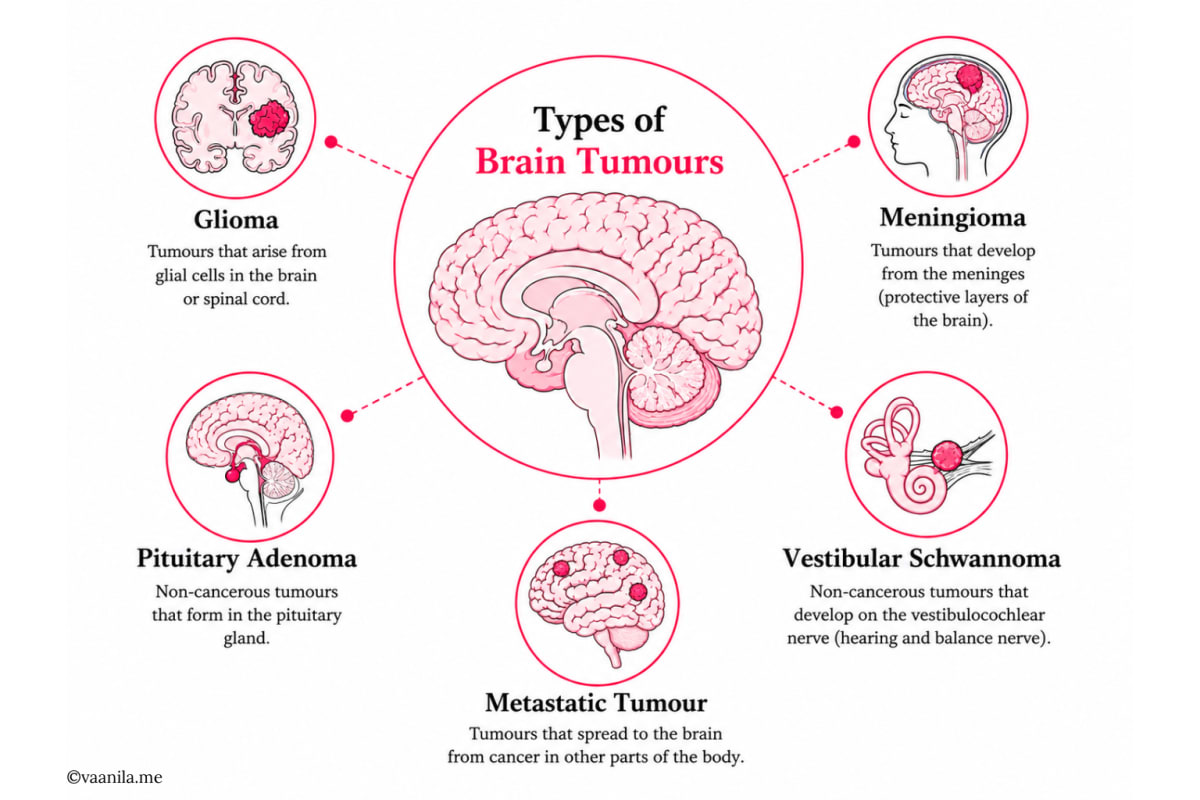
Brain tumours are classified according to the cell or tissue of origin, tumour behaviour, histology, and increasingly, molecular and genetic features. Modern classification helps guide prognosis and treatment planning.
Gliomas
Gliomas arise from glial cells, which support and protect neurons. They include astrocytomas, oligodendrogliomas, ependymomas, and glioblastomas. Some gliomas are slow-growing, while others are aggressive and infiltrate surrounding brain tissue.
Meningiomas
Meningiomas arise from the meninges, the protective coverings of the brain and spinal cord. Many are benign and slow-growing, but they can cause symptoms when they compress nearby brain structures.
Vestibular Schwannomas / Acoustic Neuromas
These benign tumours arise from Schwann cells of the vestibular nerve. They may cause hearing loss, tinnitus, balance problems, vertigo, or facial numbness.
Pituitary Adenomas
Pituitary adenomas arise from the pituitary gland. They may cause hormonal imbalance, menstrual changes, infertility, growth changes, fatigue, or visual disturbance due to pressure on the optic chiasm.
Vascular Tumours and Angiomas
These lesions involve abnormal blood vessels. Some remain asymptomatic, while others may cause seizures, neurological deficits, or bleeding.
Metastatic Brain Tumours
Metastatic tumours occur when cancer cells spread to the brain from another site in the body. They are common in adults and require treatment of both the brain lesion and the primary cancer.
Causes and Risk Factors
The exact cause of most brain tumours is not fully known. Brain tumour development is usually linked to complex genetic and molecular changes that affect normal cell growth and repair. In many patients, no single clear cause can be identified.
Exposure to ionizing radiation, especially previous radiation therapy to the head.
Inherited genetic syndromes such as Neurofibromatosis Type 1 or 2, Li-Fraumeni syndrome, Tuberous Sclerosis Complex, and Von Hippel-Lindau disease.
Family history of certain central nervous system tumours.
Immune deficiency or immunosuppression.
Previous cancers that can spread to the brain.
Increasing age, although some brain tumours also occur in children.
Common lifestyle concerns such as mobile phone use, diet, or routine environmental exposure are often discussed by the public, but strong conclusive evidence for most suspected environmental causes remains limited. Patients should rely on specialist medical advice rather than fear-based claims.
Pathophysiology: How Brain Tumours Affect the Brain
Brain tumours affect the nervous system through direct tissue invasion, pressure effects, swelling, and disruption of normal brain circulation and cerebrospinal fluid flow.
Mass effect
As the tumour grows, it can compress nearby brain tissue, blood vessels, and cranial nerves.
Cerebral edema
Tumours may disrupt the blood-brain barrier, causing fluid leakage and swelling around the lesion.
Increased intracranial pressure
Tumour growth, edema, and fluid obstruction increase pressure inside the skull, which may reduce cerebral perfusion and worsen neurological function.
Obstruction of cerebrospinal fluid flow
Tumours can block normal cerebrospinal fluid circulation and cause hydrocephalus.
Brain herniation
Severe uncontrolled intracranial pressure may shift brain tissue from one compartment to another, which is life-threatening.
Signs and Symptoms of Brain Tumours
Symptoms vary depending on tumour location, size, growth rate, and pressure effects. Some symptoms develop gradually, while others appear suddenly, especially if bleeding, seizures, or rapid swelling occurs.
General Symptoms of Increased Intracranial Pressure
Persistent or worsening headache, often worse in the morning
Nausea and vomiting not clearly related to food intake
Blurred vision, double vision, or papilledema
Drowsiness, confusion, or reduced level of consciousness
Seizures, especially new-onset seizures in adults
Personality, mood, memory, or behavioural changes
Symptoms Based on Tumour Location
Affected Area | Possible Symptoms |
|---|---|
Frontal lobe | Personality changes, impaired judgment, emotional changes, weakness, speech difficulty. |
Parietal lobe | Sensory loss, difficulty recognizing objects, spatial awareness problems. |
Temporal lobe | Memory problems, speech/language difficulty, auditory hallucinations, focal seizures. |
Occipital lobe | Visual field defects, visual hallucinations, or vision loss. |
Motor cortex | Focal seizures, weakness, or paralysis on the opposite side of the body. |
Cerebellum | Ataxia, poor coordination, imbalance, nystagmus, dizziness. |
Cerebellopontine angle | Tinnitus, vertigo, progressive hearing loss, facial numbness or weakness. |
When to Seek Urgent Medical Care
First-time seizure or repeated seizures.
Sudden weakness, facial drooping, difficulty speaking, or loss of consciousness.
Severe headache with vomiting, confusion, or vision loss.
Progressive neurological symptoms such as worsening balance, memory, personality, speech, or vision problems.
Diagnostic Evaluation
Diagnosis requires careful history taking, neurological examination, imaging, and sometimes tissue diagnosis. The aim is to identify the tumour type, location, size, grade, and effect on surrounding structures.
Neurological examination to assess cranial nerves, motor function, sensation, coordination, reflexes, speech, vision, and cognition.
MRI brain with contrast, commonly preferred for detailed tumour evaluation.
CT scan, especially in emergency settings or when MRI is not immediately available.
PET scan in selected cases to assess tumour activity or metastatic disease.
EEG when seizures are present or suspected.
Cerebral angiography for selected vascular tumours or pre-operative planning.
Lumbar puncture / cerebrospinal fluid cytology only when clinically appropriate and safe.
Stereotactic biopsy or surgical biopsy for histopathology and molecular diagnosis.
Treatment and Management
Brain tumour treatment is individualized. Management depends on tumour type, grade, location, symptoms, patient age, general health, neurological status, and molecular markers. Care is usually provided by a multidisciplinary team.
Surgery
Surgery aims to remove as much tumour as safely possible while preserving neurological function. It may be curative, diagnostic, or palliative depending on the tumour.
Radiation Therapy
Radiation therapy uses targeted radiation to control tumour growth. Techniques may include external-beam radiotherapy, stereotactic radiosurgery, or other specialized approaches.
Chemotherapy
Chemotherapy may be used for selected tumours, either alone or with surgery and radiation. The treatment plan depends on tumour histology and molecular features.
Targeted Therapy and Immunotherapy
Modern neuro-oncology increasingly uses molecular testing to guide targeted therapies and emerging treatment approaches in selected patients.
Supportive Medical Management
Supportive care may include corticosteroids for edema, anti-seizure medicines when indicated, pain control, antiemetics, nutritional support, and management of complications.
Rehabilitation and Supportive Care
Brain tumour recovery is not limited to tumour removal or cancer treatment. Many patients need rehabilitation to regain independence and improve quality of life.
Physiotherapy to improve strength, balance, mobility, and coordination.
Occupational therapy to support daily activities and safety at home.
Speech and language therapy for communication and swallowing difficulties.
Neuropsychological support for memory, attention, mood, and behaviour changes.
Nutritional support to maintain strength during treatment.
Psychological counselling and caregiver support.
Nursing Management of Brain Tumour Patients
Nurses play a central role in monitoring neurological status, preventing complications, supporting treatment, and educating patients and families.
Perform regular neurological assessments and document changes accurately.
Monitor vital signs, level of consciousness, pupil size and reaction, limb strength, and signs of increased intracranial pressure.
Maintain seizure precautions and administer anti-seizure medications as prescribed.
Assess swallowing ability and reduce aspiration risk.
Support adequate nutrition, hydration, oral care, skin care, and pressure injury prevention.
Maintain a safe environment to prevent falls and injury.
Provide emotional support and orientation for patients with confusion or cognitive changes.
Educate families about warning signs, medication adherence, follow-up appointments, rehabilitation needs, and emergency symptoms.
Coordinate care with physicians, therapists, dietitians, psychologists, social workers, and palliative care teams when needed.
Patient and Family Education
Do not ignore progressive headaches, seizures, visual changes, speech problems, weakness, or behaviour changes.
Keep a symptom diary and report new or worsening neurological signs promptly.
Take medications exactly as prescribed, especially anti-seizure medicines and steroids.
Attend follow-up imaging and specialist appointments.
Ask the healthcare team about activity restrictions, driving, work, pregnancy planning, and seizure safety.
Seek emotional and caregiver support early, as brain tumour care can be physically and psychologically demanding.
Prognosis
The prognosis of a brain tumour varies widely. Some benign tumours can be successfully controlled with surgery or observation, while aggressive malignant tumours may require combined treatment and long-term follow-up. Important prognostic factors include tumour type, grade, molecular features, location, extent of resection, response to treatment, and the patient’s overall health.
Conclusion
Brain tumours are a diverse group of intracranial growths that may affect neurological, cognitive, emotional, and physical function. Early recognition of symptoms, timely imaging, accurate diagnosis, multidisciplinary treatment, skilled nursing care, and rehabilitation are essential for improving outcomes and quality of life. World Brain Tumour Day reminds us to promote awareness, support patients and caregivers, and encourage continued research for better treatment and survivorship.
Written by Vaanila Swarnamyuran
Registered Nurse
MSc Medical Surgical Nursing
TNNMC No. 205047
References
Journals
- 1.The 2021 WHO Classification of Tumors of the Central Nervous System: a summaryDavid N. Louis, Arie Perry, Pieter Wesseling, Daniel J. Brat, Ian A. Cree, Dominique Figarella-Branger, Cynthia Hawkins, H. K. Ng, Stefan M. Pfister, Guido Reifenberger, Riccardo Soffietti, Andreas von Deimling, David W. EllisonNeuro-Oncology
- 2.Symptom management in adult brain tumours: A literature reviewRong Zhang, Dong-Mei Wang, Yong-Li Liu, Ming-Li Tian, Li Zhu, Jing Chen, Juan ZhangNursing Open
Books
- 1.Brunner & Suddarth's Textbook of Medical-Surgical NursingJanice L. Hinkle and Kerry Cheever
Web Links
Related Articles
Cerebrovascular Accident (Stroke): Causes, Symptoms, Diagnosis, Treatment, Prevention, and Rehabilitation.
Learn More